Thursday, September 27, 2012

How to adjust the temperature on a Francis Francis X1


Francis Francis X1 internals

This post is actually from January 2012 originally written by Hendrup, but I have rewritten it quite a bit and thought it would be a great read for people who struggle with their X1s in producing balanced shots.

Not many know that you can actually adjust the temperature on a Francis Francis X1. While the little machine isn't the greatest machine, being a really bad steamer and it's the lack of a three way valve, it's really not that bad at all. With a little tweaking and experience it is capable of brewing some delicious shots. Some Francis Francis machines are equipped with a PID (Proportional–Integral–Derivative) controller. In simple terms a PID is capable of controlling the temperature with a much tighter dead band (dead band being the top and low of the boiler temperature), than a traditional thermostat is. A thermostat in for example the Rancilio Silvia varies up to 20 degrees, while a PID only varies a degree or two. Some top of the line espresso machines have a adjustable PID control on the front of the machine, while that isn't the case on the X1, you can actually adjust the temperature.
I have searched the entire web (THE ENTIRE WEB) and haven't found a single solution on how to adjust the temperature on the X1 model, so I popped the hood on my own espresso machine and got going. I found my shots being overly sour, so I located the internal PID and adjusted the temperature up to about 95 degrees, which gave a much better balanced espresso. If you got a Francis Francis X1 and are brewing some sour or bitter shots it might be because of the water temperature. Here is a guide on how to adjust to temperature on a Francis Francis X1.

Tuesday, September 25, 2012

Thursday, September 20, 2012

Facebook comments integration


It’s now possible to comment using your Facebook login, while the comments are still not used much on the site; I hope it will change in the future. If you would like the same thing on your blog I followed this tutorial: http://jensontaylor.blogspot.dk/2012/03/integrate-facebook-comments-for-blogger.html
And lastly don't forget our Facebook page, it's a great way to keep you updated! www.facebook.com/CoffeeChannel

Tuesday, September 18, 2012

New design!

Yes, as you might have noticed I have changed the design. Actually I liked the old design, but there were some problems with both readability and scrolling bugs on Safari which 30% of the visitors use. The new and simpler design features a new and smaller top banner, which should contribute to a better exploration of the screen real estate. It also features a sidebar which showcases the most popular posts and later a label tag cloud. The design is based on the simple template, with is for me the perfect template as the focus is on the blog post and nothing else really. I have kept the colors relatively conservative making the banner pop without putting too crazy saturated colors in there. Lastly I have placed a navigation bar to make it quicker to find what you are looking for, I will begin labeling posts from now on. I hope you enjoy it, if not, please let me know.

Monday, September 17, 2012

Review: El Salvador Honey Processed Bourbon Cajamarca Single Estate

Green and roasted coffee beans

This coffee from El Salvador has been one of my favorite coffees for the last 6 months or so. The coffee has one of the most complex sweetnesses I have ever tasted, which tastes both like honey and sweet chocolate with a citrusy finish. But what really blows my mind is the coffees viscosity, which when roasted just right is almost like butter.
The coffee is honey processed, which is a process where the coffee beans isn’t washed clean before drying in the sun, it is thus dried with part of the pulp still on, which produces an instance sweetness in the coffee. This process is also known as semi-washed coffee.

Tuesday, September 11, 2012

How to effortlessly steam milk using only one hand


Latte art

One of the things that seem to bring the most headaches to people when first taking their new machines out for a spin is how to steam the milk and create that smooth microfoam used for latte art. I have tried a lot of different techniques and made a lot of mess trying to perfect my microfoam.

Saturday, September 8, 2012

Brew ratio


Why weighing the coffee is a more accurate way then measuring by volume? 


An espresso is typically defined as a small liquid extracted under pressure by an espresso machine at approximately 9 bars. For a single the volume is about 30 ml and 60 ml for a double. So far, so good, but there is a problem with this way of measuring and the nature of coffee especially in regards to espresso. 

Monday, September 3, 2012

Pop Chart’s Compendious Coffee Diagram


The chart masters over at Pop Chart Lab have just released an impressively comprehensive flow chart that diagrams the various elements required for all manner of coffee drinks. Including various types of grinders, brew methods, mixers, and the resulting beverages they create. The listed brew methods even include such new and notable options such as the Steampunk and Able Kone.


Overall, it’s one of the most accurate—and impressive—coffee illustations I’ve seen on the web. While obviously well researched, I noticed two glaring mistakes: the categorization of the AeroPress as an espresso maker and (most odd), connecting the “cupping” brew method to iced coffee. It may be too late for corrections, but either way, Pop Chart Lab will be printing 500 of them large scale, for wall hanging glory.

Zoom in and explore the full scale version at Pop Chart Lab

Friday, August 31, 2012

The Able Kone


Less than three months after Able launched their successful Kickstarter campaign to fund a production run of its latest Kone coffee filter, their beautifully designed white boxes have begun appearing in mailboxes and Instagram feeds around the world.

The new Kone and soon to be released ceramic brewer raised $150,000 more than the initial $5000 requested for tooling and production costs. Now with over 1200 backers supporting Keith Gehrke, the founder of Able Brewing, it’s become clear that his company’s new life after Coava, will create a bright new path on its own.


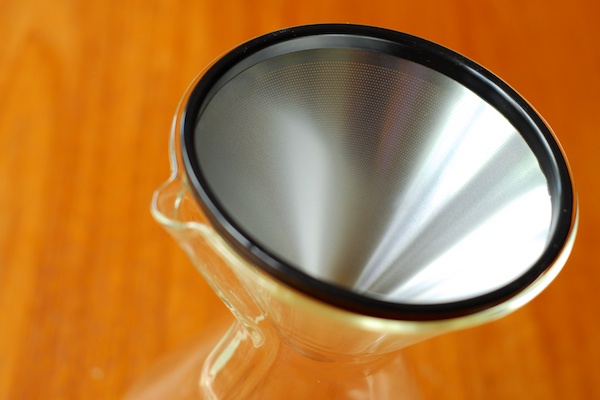
The Kone is a reusable, stainless steel coffee filter originally designed to fit the Chemex coffee maker, but can really be used with any vessel that supports its size and shape. The filter uses hundreds of thousands of micro-sized holes, created using a process of photo-etched steel, to form a precise filter pattern for uniform extraction.

I prefer not to compare the Kone with Chemex paper filters, because there is little comparison in the resulting coffee. The Kone is a unique brew method that incorporates pour over techniques to produce a heavier, oil-rich brew that’s still cleaner than a French press, which many people enjoy more than paper.


I’ve used the Kone since the first version was released more than 2 years ago. It’s been great following the progression of the filter and the company as it’s been refined over the years. The third and newest version is no exception.

The most obvious changes in the new design is the black plastic ring around the edge along with a new blunted tip. My reaction to the black ring was negative at first for altering the elegant, streamlined aesthetic of previous versions (it also slightly affects how well it sits in a Chemex).

However, once I handled the new Kone, the extra rigidity added to the shape and structure by the plastic ring becomes obvious and appreciated. For the coffee shops who use the Kone all day long, the new lip will greatly improve emptying spent grounds and seemingly extend the filters overall life.


The new blunted tip not only makes the Kone safer to handle, but it eliminates the small gap found on the tip of older versions, which was a clear path for fine grounds that increase sediment in the cup. This new “cap” plays a part in catching fines and helping produce a cleaner cup overall than the previous Kones.

With even smaller holes and a new pattern that becomes more concentrated near the tip, the new Kone offers more uniform passthrough as well. More of the water makes its way to the bottom, instead of leaking dramatically through the sides of the filter.


When the first Kone came out, I thought it looked incredible and worked great. It was new and there was nothing to compare it with. Once version 2 came out, the first one suddenly looked and felt like a prototype and the quality of the brew greatly improved.


The latest version, while losing some of its elegance, looks like a retail-ready product that could be sold on the shelves of Williams-Sonoma. From the packaging to the product itself, there’s a much greater feeling of value.


Below I’ve run an experiment to illustrate the progression of the Kone and how much the sediment has been reduced with each new version.

I brewed coffee with each version of the Kone using the same parameters and technique: 40 grams of coffee to 600 grams of water, 30 second bloom followed by a slow and steady center pour, using a medium grind (5-O on a Baratza Vario-W).


After each coffee was done brewing, I poured the result through a rinsed, white V60 filter to capture the sediment. Results pictured below begin with version 1.


Overall, the new Kone is a great improvement over its predecessor. From its reinforced new structure to the increased clarity in the cup—if you were a fan of previous versions then you’ll love the latest. If you’re just now discovering the Kone or have been waiting to purchase one, this is definitely the best version so far and you’ll be happy you waited.

Tuesday, August 28, 2012

Rocket R58: Final News!


The Rocket R58 dual boiler espresso machine 

This will be the last update of the Rocket R58 before a hopeful real review of the dual boiler, which Im looking forward too a lot. Nevertheless in the meantime Whole Latte Love have produced two videos from May regarding this newly launched espresso machine and it's kind of interesting because one of the videos actually shows the inside of the Rocket R58.